How Long Does LASIK Last? Is LASIK Permanent?
- By Centre For Sight
- 6 minutes
Blog Summary
- LASIK permanently reshapes the cornea to correct vision, reducing dependence on glasses or contact lenses
- Most patients enjoy clear vision for 10?20 years or longer, with ~95% achieving 20/40 vision or better
- LASIK is permanent, but overall vision can still change due to aging
- LASIK does not wear off; vision changes happen due to natural eye conditions
- Common causes of post-LASIK vision changes: presbyopia, cataracts, refractive regression, and other eye diseases
- Best results are seen in patients with stable prescriptions and moderate eye power before surgery
- High screen time, diabetes, and lifestyle factors can impact long-term visual clarity
- LASIK has a 95?98% success rate in India, making it a safe and reliable option
- Enhancement (touch-up) procedures are possible if vision changes significantly
- Reading glasses may still be needed after 40 due to natural aging (presbyopia)
Good eyesight helps you enjoy your daily activities effectively. With innovations in the eye care industry, such as LASIK surgery, it is now possible to achieve clear eyesight without wearing eyeglasses. But there is a lot of debate about the longevity of clear eyesight after LASIK surgery. In this blog post, you will learn about LASIK surgery, how long it lasts, the factors that influence it, and more.
What is LASIK and How Does it Work?
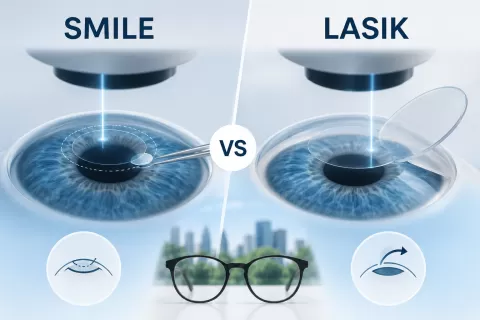
LASIK (Laser-Assisted In Situ Keratomileusis) is a highly advanced refractive surgery used to correct common vision problems like myopia (nearsightedness), hyperopia (farsightedness), and astigmatism. The procedure reshapes the cornea, the clear front part of the eye, so that light focuses correctly on the retina. This results in clearer vision and significantly reduces or eliminates the need for glasses or contact lenses. Here's how it works:
- A thin flap is created on the cornea using a femtosecond laser or microkeratome
- An excimer laser reshapes the underlying corneal tissue
- The flap is repositioned, and healing begins naturally without stitches
How Long Does LASIK Last?
Now, we'll address the most searched question directly: how long does LASIK last? In most cases, LASIK provides long-term vision correction that lasts 10?20 years or even a lifetime. Studies suggest that nearly 95% of patients achieve 20/40 vision or better, with a large percentage achieving 20/20 vision. However, while the corneal reshaping is permanent, your eyes are still biological organs that age over time. So, the results are long-lasting, but not immune to natural changes.
Is LASIK Permanent?
Many people search for LASIK eye surgery permanent results in India, especially given the rising popularity of LASIK in metro cities like Delhi, Mumbai, and Hyderabad. The things to note are:
- The corneal correction is permanent
- Your overall vision may still change over time
Think of LASIK like fixing the lens of a camera. The correction is applied once, but external factors (such as aging or wear and tear) can still affect image quality over time. In India, where screen exposure is high and lifestyle diseases like diabetes are increasingly common, these factors can influence long-term outcomes.
Does LASIK Wear Off After Years?
This is probably the most-searched question by people who had LASIK five or more years ago and have started having slightly blurred vision.? The answer is that LASIK does not wear off. What actually happens is:
- Your eyes undergo natural changes
- New vision issues may develop unrelated to the surgery
Here are the common reasons why vision may change:
- Presbyopia
This age-related change affects people in their early to mid-40s. The natural lens of the eye stiffens and loses flexibility, making it hard to focus on close objects. Reading food menus, phone screens, or medicine labels becomes a squinting exercise. LASIK corrects the cornea, not the lens, so presbyopia develops regardless of whether you had the surgery.
- Refractive regression
In a small number of patients, more likely those who had very high prescriptions before LASIK (say, -8.00 D or above), the cornea can subtly shift back toward its original shape over the years. This is more common in high myopes and is why surgeons often counsel patients with extreme prescriptions about realistic expectations.
- Cataracts
Cataracts, which are extremely common in India, are the leading cause of blindness. As the natural lens clouds over, often accelerated by UV exposure, diabetes, or simply age, vision deteriorates. This is completely independent of LASIK. India performs millions of cataract surgeries annually, a significant portion of which are on people who also had refractive surgery earlier in life.
- Other conditions
Glaucoma, diabetic retinopathy, and macular degeneration can also affect vision in the long term.
Factors that Affect How Long LASIK Results Last
When looking at the LASIK surgery longevity success rate India, a few factors show up in the data as predictors of how long results hold:
- Age during surgery
Patients who undergo LASIK between 22 and 35, with a stable prescription for at least 2 years, tend to have the best long-term outcomes. Surgeons across major eye hospitals typically require prescription stability as a pre-condition for candidacy.
- Pre-surgical prescription strength?
Mild to moderate myopia (up to -6.00 D) shows greater long-term stability than high myopia (-8.00 D and above). High prescriptions require more corneal tissue removal, leaving less buffer for any future enhancements and a slightly higher risk of regression.
- Corneal thickness?
Indians, on average, tend to have thinner corneas than those in Western populations, a factor that surgeons routinely assess with corneal topography before clearing a patient for LASIK. Adequate thickness is critical for both initial safety and future enhancement options.
- Lifestyle factors
Today's workforce is prone to prolonged screen exposure, with urban professionals averaging 9?10 hours of screen time daily. This doesn't reverse LASIK results, but it can accelerate digital eye strain and dry eyes, which are among the most common complaints in the years following surgery.
- Diabetes prevalence
Uncontrolled blood sugar causes fluctuations in refraction and is a contraindication for LASIK. Patients with diabetes who proceed with surgery (under controlled conditions) may experience faster vision changes.
Can LASIK Be Redone?
Yes, LASIK can be enhanced or redone in some cases. Enhancement (touch-up) is possible if:
- Vision has significantly changed
- Corneal thickness is sufficient
- No underlying eye disease is present
Conclusion
LASIK eye surgery is one of the most reliable methods to correct one's vision. However, the operation will reshape the cornea, but it will not halt the natural process of aging. It will also not guarantee the absence of future eye diseases. The good part is that in most cases, LASIK provides years of problem-free vision and freedom from glasses. Hence, the decision is yours. If you want to try it, visit your ophthalmologist for a consultation.?


Frequently Asked Questions
How long does LASIK last?
Does LASIK wear off after years?
Is LASIK safe in the long run?
What is the longevity success rate of LASIK surgery in India?
Do I need to wear reading glasses again after LASIK?
Could not find what you are looking for?


